The "open source is free" trap (and what this article actually compares)
Here is the claim to hold onto: in 2026, an open-weight model — a model whose trained parameters you can download and run yourself, like Llama, Mistral or DeepSeek — is free to obtain but never free to run. The weights cost $0; inference (the act of running the model to generate output) costs real money in GPUs and engineer-hours. So the honest comparison is not "free open source vs paid API." It is "you pay a variable, predictable per-token bill to a closed API" versus "you pay a fixed, lumpy bill for hardware and people." As of 2026, self-hosting only wins once you sustain roughly 50–200M+ tokens a month, or you have a hard data-residency rule. Below that, the fixed cost dominates and the API is cheaper. This article does the arithmetic for both, with real 2026 ranges, so you can trust the math for your volume.
Quick aside before the math: a lot of this "host it or pay for it" agonizing disappears if you don't run infrastructure at all. Zerocoder puts GPT-5, Claude, Gemini and 25+ AI tools behind one account and one shared balance — no per-provider billing, no GPUs, no code. You get free starter credits to test before you commit a cent.
Free weights ≠ free inference
When people say "this model is open source and free," they mean the license lets you download the weights and use them commercially without paying the lab. That part is genuinely $0. But those weights are inert until you load them onto a GPU and run them. A token — the roughly-word-sized chunk models read and write — costs a fraction of a cent to generate on a closed API, and it costs a fraction of a cent on your own GPU too. The difference is that on the API you pay only for tokens you actually use, while on your own hardware you pay for the GPU whether it is generating tokens or sitting idle overnight. "Free" describes the download, not the electricity, the rental, or the person keeping it online.
The two questions that decide everything: your token volume + your privacy needs
Nearly every real decision here collapses into two variables. First, how many tokens per month do you actually process? A prototype pushing a few thousand tokens a day and a product pushing 300M a month live in different universes. Second, do you have a legal or contractual reason data cannot leave your infrastructure? If the answer to the first is "not that many" and the second is "no," you almost certainly should not self-host in 2026. If you sustain enormous volume, or a regulator forbids sending data to a third party, self-hosting starts to earn its keep. Everything below is really just putting numbers on those two questions.
How closed-API pricing really works in 2026
Closed-API pricing in 2026 is metered, per-token, and split into input and output — and output tokens cost several times more than input. As rough current ranges: flagship models (GPT-5-class, Claude, Gemini top tier) run about $1–$5 per million input tokens and $5–$20 per million output tokens, while small/fast models drop to roughly $0.10–$0.50 input and $0.30–$1.50 output per million. Because you pay only for what you send and receive, your bill scales linearly with usage and is easy to forecast: model your average request size, multiply by volume, add a margin. The bill is predictable precisely because it is variable — no request, no charge. It spikes only when your product suddenly gets popular, when prompts balloon, or when you leave caching off. If you want a wider view of what a real 2026 AI tool stack costs per month, that companion piece breaks down the subscription side; here we stay on raw token economics.
Cost per million input/output tokens
The single most common budgeting mistake is quoting one price and forgetting that output is the expensive half. A chat that reads 500 tokens and writes 1,500 is dominated by the output rate. Always model both. A practical 2026 shortcut: for a chat-style workload, assume a blended rate — one number that averages input and output weighted by your real ratio — of roughly $3–$8 per million tokens on a flagship model and $0.30–$1.00 on a small model. Blended rates are what you multiply against volume for a fast estimate.
Cached tokens, batch discounts, context windows
Providers now hand you real levers to cut the bill. Prompt caching lets you reuse a long, static system prompt at a steep discount (often 50–90% off the input rate for the cached portion) instead of paying full price every call. Batch processing — submitting non-urgent jobs to run within a window — typically knocks about 50% off. Larger context windows (how much text the model can consider at once) are convenient but not free: stuffing 100K tokens of context into every request multiplies your input cost. Used well, caching plus batching can halve a real bill without touching your model choice.
Why the bill is predictable (and where it spikes)
Because charges track usage one-to-one, a closed API bill behaves like a utility meter — boring, which is good. It spikes in three predictable ways: a traffic surge (more users, more calls), prompt bloat (someone appends the whole knowledge base to every message), or a silent tier or credit change. Pricing tiers do move, and it is worth understanding how closed-API pricing tiers shifted in 2026 so a mid-quarter adjustment doesn't surprise your finance sheet. The point stands: variable and forecastable beats fixed and lumpy for most teams.
The true cost of self-hosting an open-weight LLM
The true 2026 cost of self-hosting an open-weight model is the GPU plus everything around it, and the "everything around it" is where budgets die. Renting a capable GPU runs roughly $0.50–$2.00 per hour for a mid-size card and $2–$8+ per hour for a top-tier accelerator, as of 2026 — call it $360–$1,500+ a month per GPU if you keep one running 24/7. On top of that you carry DevOps and MLOps time to deploy, monitor, patch and scale it; redundancy so a single node failure doesn't take you down; and the ongoing churn of model updates. The strong open weights driving all this interest — including the open-weight models coming out of China like DeepSeek — are genuinely excellent and genuinely free to download. The catch is that a free model on a $1,000/month GPU that sits 80% idle is not cheap; it is a fixed cost you pay whether anyone uses it or not.
GPU rental — serverless vs dedicated (per-hour reality)
You have two shapes of GPU cost. A dedicated GPU is rented (or owned) by the hour or month and is yours around the clock — you pay for every hour, busy or idle. A serverless GPU spins up on demand and bills per second of actual compute, so idle time costs nothing, but per-second rates are higher and cold starts add latency. The rule: bursty or low-volume traffic favors serverless; steady high traffic favors dedicated. A prototype that fires a few requests an hour on a 24/7 dedicated card is the worst of both worlds — you pay full-time rent for part-time work.

The four costs people forget: idle GPU time, DevOps hours, scaling/redundancy, model updates
- Idle GPU time. Real utilization for a small product is often 10–30%. If your card is busy 20% of the time, your effective cost per token is roughly 5× the naive "GPU hourly ÷ tokens per hour" number.
- DevOps / MLOps hours. Someone has to deploy, containerize, monitor, and get paged at 2 a.m. Even a few hours a week at engineer rates is often $1,000–$4,000+ a month of loaded cost — frequently larger than the GPU bill itself.
- Scaling and redundancy. One GPU is a single point of failure. Real uptime means a second node, a load balancer, and health checks — so "one GPU" quietly becomes two or three.
- Model updates. A better open weight ships every few months. Staying current means re-testing, re-benchmarking, and re-deploying — recurring engineer time, not a one-off.
Fine-tuning: cheaper than you fear, dearer than "free"
Fine-tuning an open model in 2026 is more affordable than most people expect — a modest LoRA-style tune on a mid-size model can cost tens to a few hundred dollars in GPU time, not the five figures folks imagine. But it is never "free," and the sticker price hides the real work: dataset preparation, evaluation, and the ongoing cost of hosting the fine-tuned result. Before you fine-tune to save money, check whether better prompting or a cheaper base model already gets you there. Fine-tuning to save cost only pays back at volume; fine-tuning for capability or style you can't prompt your way to is a different, often better, reason.
Side-by-side: a real cost model (3 scenarios)
Put in numbers, the picture is stark at both ends and blurry in the middle. As of 2026, a hobby prototype costs pennies to a few dollars a month on an API and $360–$1,500+ to self-host — the API wins by a mile. A high-volume product flips it: at hundreds of millions of tokens a month, self-hosting's fixed cost gets amortized and can undercut the API. The three scenarios below use realistic ranges, blended token rates, and — crucially — include the human cost of self-hosting, which is the line most comparisons quietly drop. Read them as ranges, not promises: GPU rates and token prices both move quarter to quarter, and your real numbers depend on utilization and prompt size.
Scenario A — hobby / prototype (thousands of tokens/day)
You're testing an idea: a few thousand tokens a day, say ~150K tokens a month. On a flagship API at a blended $5/M that's under a dollar; even heavy testing rarely tops a few dollars.
| Cost line | Closed API | Self-host (dedicated GPU) |
|---|---|---|
| Compute | ~$1–$5 / mo | $360–$1,500+ / mo (idle-heavy) |
| DevOps time | $0 | $500–$2,000+ / mo |
| Redundancy | Included | Extra node if you need uptime |
| All-in / month | ~$1–$5 | ~$900–$3,500+ |
Verdict: the API wins by two or three orders of magnitude. Buying or renting a GPU for a prototype is the classic money-burner.
Scenario B — growing product (millions of tokens/day)
Now you're live: ~3M tokens/day, roughly 90M tokens a month, mixed input/output. At a blended $4/M the API runs about $360/month; push a chunk to a small model and it drops further.
| Cost line | Closed API | Self-host |
|---|---|---|
| Compute | ~$300–$700 / mo | $700–$3,000 / mo (1–2 GPUs) |
| DevOps time | $0 | $1,500–$4,000 / mo |
| Scaling/redundancy | Included | $500–$1,500 / mo |
| All-in / month | ~$300–$700 | ~$2,700–$8,500 |
Verdict: still the API, comfortably — unless you have engineers whose time is already sunk and utilization you can drive high. This is the murky zone where "we could self-host" tempts people and the DevOps line quietly kills the savings.
Scenario C — high-volume / strict data residency
You're at ~1B tokens a month, or you legally cannot send data off-prem. At a blended $4/M the API bill is roughly $4,000/month and climbing with growth; here a well-utilized fleet finally amortizes.
| Cost line | Closed API | Self-host (high utilization) |
|---|---|---|
| Compute | ~$4,000+ / mo (scales with volume) | $2,000–$6,000 / mo (fleet) |
| DevOps team | $0 | $3,000–$8,000 / mo |
| Redundancy | Included | Built into fleet |
| All-in / month | ~$4,000+ (variable) | ~$5,000–$14,000 (fixed) |
Verdict: genuinely close, and it tips to self-host as volume keeps rising or when data residency is non-negotiable — because at that point the API isn't an option at any price. This is the scenario where self-hosting earns its keep.
The break-even point: at what volume does self-hosting win?
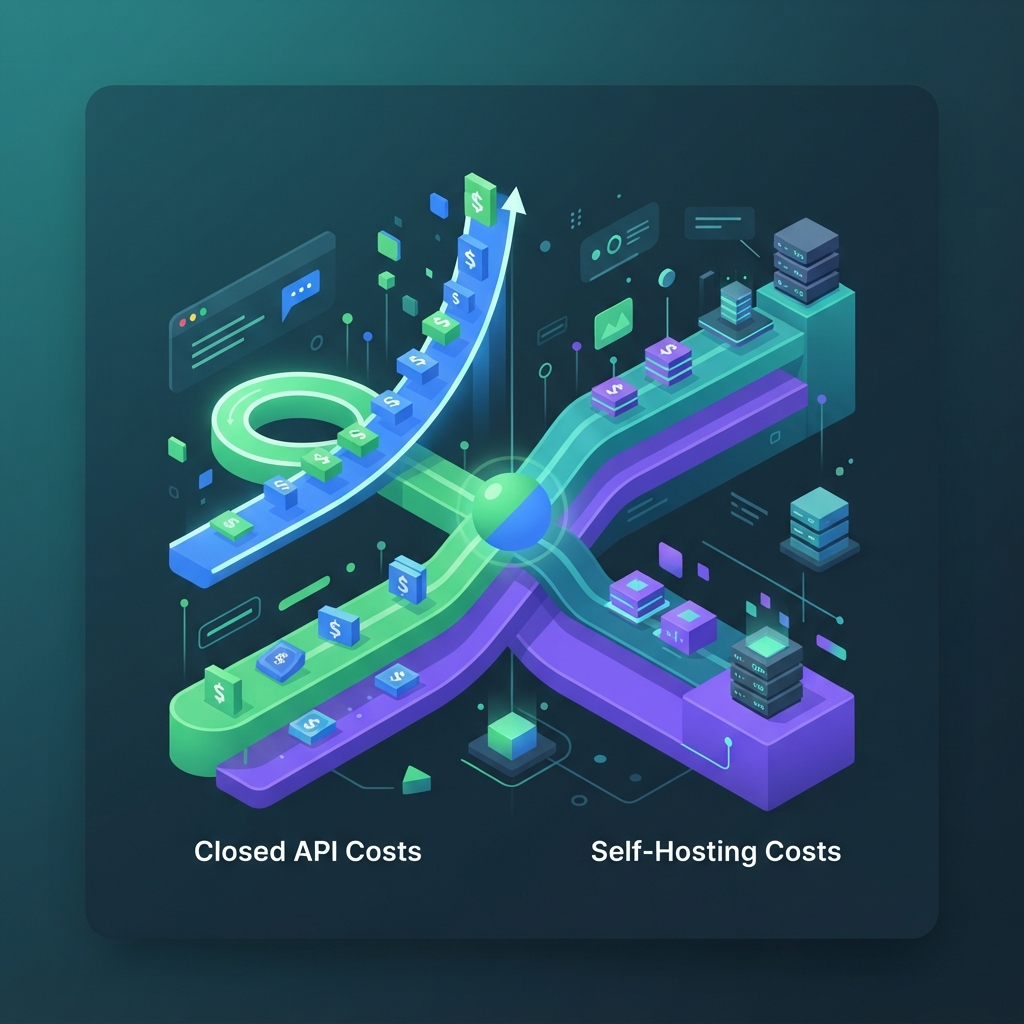
The break-even point in 2026 sits at sustained high volume — roughly 50–200M+ tokens a month at high GPU utilization — not at prototype scale. Below that band, the fixed GPU-plus-DevOps cost is larger than any per-token API bill, so the API is cheaper and simpler. Above it, if you can keep the hardware genuinely busy, the fixed cost spreads across enough tokens to undercut metered pricing. The band is wide because it hinges on utilization: a card that's 20% busy pushes break-even far higher; a card that's 80% busy pulls it in. And it moves — every time API prices drop or GPUs get cheaper, the crossover shifts. Treat any single "you break even at X tokens" number with suspicion and re-run the math against current rates.
The rough formula (tokens/month × price vs fixed GPU + ops)
Here is the arithmetic, kept deliberately simple. Compare these two lines:
monthly API cost ≈ tokens/month × blended price per token
self-host ≈ (GPU hours × rate) + DevOps hours + updates
The API line rises with usage from zero. The self-host line starts high — you pay the GPU and the people from token one — and barely moves as volume grows. Where the rising API line crosses the flat self-host line is your break-even. If your realistic volume sits left of that crossing, use the API. If it's durably to the right, and utilization is high, self-hosting starts to pay.
Why break-even keeps moving (API prices fall, GPUs get cheaper)
Two trends drag the crossover around. API prices have fallen steadily as competition and efficiency improve, which pushes break-even up — you need even more volume to justify hosting. Meanwhile GPUs and serverless rates also get cheaper and utilization tooling improves, which pushes break-even down. The net effect wobbles quarter to quarter. Practical takeaway: don't commit to hardware based on last year's spreadsheet. Recompute with today's token prices and today's GPU rates before you sign anything.
Beyond price: privacy, control, lock-in and latency
Cost isn't the only axis, and sometimes it isn't even the deciding one. Beyond the dollars, four factors matter: data privacy and residency (can the data legally leave your walls?), control (do you need a frozen model version that never changes under you?), vendor lock-in, and latency. Of these, hard data-residency rules are the one factor that can justify self-hosting regardless of the token math — if a regulator or contract forbids sending data to a third-party API, price becomes secondary because the API simply isn't allowed. The others are more nuanced and often overstated. If you genuinely reach the conclusion that you need an on-prem or private deployment, it's usually faster to hire an AI automation expert to stand it up correctly than to learn MLOps under deadline.
When data-residency alone justifies self-hosting
Some workloads carry data that legally or contractually cannot touch an external provider — certain healthcare, government, or regulated-finance cases. When that's real (not just a nice-to-have), self-hosting or a private deployment isn't a cost decision, it's a compliance requirement, and the break-even math is moot. The trap is invoking "privacy" reflexively when no rule actually forbids a compliant API. Most reputable closed APIs in 2026 offer data-handling terms, no-training guarantees, and regional processing that satisfy a large share of privacy concerns. Confirm whether you have a hard requirement or a soft preference before you buy hardware over it.
Vendor lock-in — overstated or real?
Lock-in fear drives a lot of premature self-hosting, and it's mostly overstated in 2026. Models now speak near-identical API shapes, so swapping providers is often a config change, not a rewrite. The real lock-in isn't the model — it's building your whole app around one vendor's unique features. You get most of the "freedom" benefit of open weights simply by keeping your integration model-agnostic and being able to route between providers, without ever touching a GPU. That's the middle path we'll get to next.
Common mistakes (that blow up either budget)
Most blown AI budgets in 2026 come from a handful of avoidable mistakes on both sides of the build-vs-buy line, and each one is easy to spot once named. The biggest: buying or renting a 24/7 GPU for a prototype, then paying $1,000+ a month for a card that's idle 90% of the time. On the API side, the classics are ignoring that output tokens cost several times more than input, running with no prompt caching so you re-pay for a static system prompt on every call, and hand-rolling infrastructure that a managed layer already gives you for free. A lot of "AI is too expensive" is really "we used it wastefully." Tightening prompts alone often cuts a bill 20–40%, and learning to do that well via Prompt Engineering from Scratch (course) pays for itself faster than any hardware purchase.
- GPU for a prototype: use an API or serverless until volume proves out.
- Ignoring output-token cost: model input and output separately; trim verbose outputs.
- No caching: cache static context and batch non-urgent jobs.
- Reinventing infra: don't build routing, billing and failover a managed layer already provides.
The middle path: managed access to many models, no infra
For most small teams in 2026, the smartest option is neither extreme — it's managed multi-model access: one account, one shared balance, many models, zero infrastructure. You skip GPU rental, DevOps rota, and per-provider billing sprawl, and you get closed-API convenience across GPT-5, Claude and Gemini without stitching three invoices together. The efficiency trick is routing: send cheap, high-volume tasks (classification, short replies) to a small cheap model, and reserve the expensive flagships for the genuinely hard requests — a discipline covered in routing each task to the right closed model. If you truly need programmatic, done-for-you access, the Zerocoder API gives you one endpoint across many models, and for a bespoke deployment you can still hire an AI automation expert. But for the common "I just want to build with a model" case, no hosting is required.
One balance instead of per-provider billing
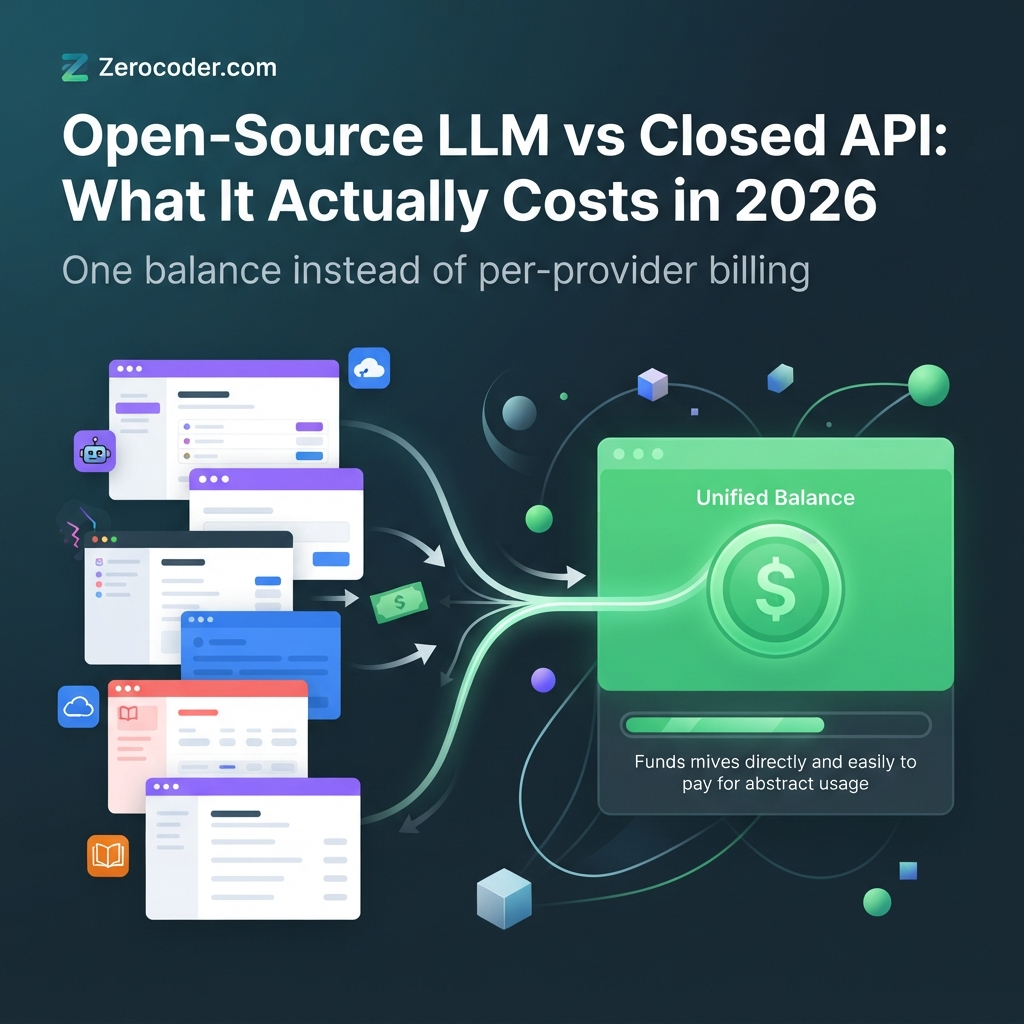
Juggling separate accounts, credit cards and rate limits for each provider is its own hidden tax — reconciliation time, surprise minimums, orphaned subscriptions. A single balance that draws down across every model turns that sprawl into one predictable line. Practically, that often means you just want to write text with AI, generate a document with AI, or create a bot — and you can do all three from one place without ever choosing a hosting strategy.
Route cheap tasks to cheap models, hard tasks to strong ones
Routing is the single highest-leverage cost move that doesn't involve infrastructure. If 80% of your calls are simple, sending them to a model that costs $0.30/M instead of $8/M cuts the dominant slice of your bill by an order of magnitude, while quality-sensitive requests still hit a flagship. Managed access makes this a routing rule rather than a second integration — the same reason it beats both "pay full flagship price for everything" and "host one model for everything."
A simple decision framework (flowchart in prose)
Walk it top to bottom and stop at your first "yes":
- Do you have a hard data-residency rule that forbids external APIs? If yes → self-host or a private deployment; the math is secondary. Bring in an expert.
- Do you sustain 50–200M+ tokens/month at high, steady utilization? If yes → run the break-even formula with current rates; self-hosting may win. If your GPU would sit idle, treat this as a "no."
- Are you a prototype, a small team, or bursty in traffic? If yes → use a managed API. Full stop. Don't buy hardware.
- Do you just want to build with a model without thinking about any of this? → managed multi-model access, one balance, and route cheap tasks to cheap models.
The uncomfortable truth: the overwhelming majority of readers land on options 3 or 4. Self-hosting is a real answer to a real, narrow set of problems — high sustained volume or hard compliance — not a default money-saver.
What's next: how to actually start today
If you've reached "I don't need to host anything, I need to use models well," start there today — no procurement, no MLOps. The fastest concrete first step in 2026 is to pick your two or three real tasks, run them through a managed workspace, and measure the actual monthly spend before you optimize anything. You can browse all 25+ AI tools to match tasks to tools, and see the full Zerocoder pricing to sanity-check the number against your own volume — the same arithmetic we've been doing, applied to you. If your conclusion is instead "we should get systematic about automating workflows," the AI Automation: n8n, Make and AI Agents (course) teaches you to wire models into real processes without standing up servers. Either way, the move is to start using models, not to start renting GPUs — and to only revisit self-hosting when your volume or compliance genuinely forces the question.
FAQ
Is an open-source LLM really free?
The weights are free to download and use, but running them is not. In 2026 you pay for GPUs (roughly $360–$1,500+/month for one card running 24/7) plus DevOps hours, redundancy and updates. "Free" describes the model file, not the inference. For low volume, a metered closed API is far cheaper than a mostly-idle GPU.
What's the cheapest way to run an LLM for a small team?
For most small teams in 2026, managed multi-model access with one shared balance is cheapest — no GPUs, no DevOps, and you pay only per token used. Route simple tasks to a small cheap model and reserve flagships for hard requests. Self-hosting rarely pays below sustained high volume, so skip the hardware until your numbers demand it.
What GPU do I need to host an LLM?
It depends on model size. A small quantized open-weight model can run on a mid-size card (~$0.50–$2/hour rented); larger models need top-tier accelerators at $2–$8+/hour, often several for redundancy. As of 2026 that's $360–$1,500+ per card per month if kept always-on — before any engineer time. Below high volume, the idle cost usually outweighs the benefit.
At what token volume should I self-host?
Roughly 50–200M+ tokens per month at high, steady GPU utilization, as of 2026 — and even then only if a managed API isn't already cheaper for your mix. Below that band, fixed GPU and DevOps cost dominates. Utilization is the swing factor: an idle card pushes break-even far higher. Recompute with current token prices and GPU rates before committing.
Does self-hosting improve privacy enough to justify the cost?
Only when you have a hard data-residency rule that legally forbids sending data to an external API. In that case cost is secondary because the API isn't an option. Otherwise, most reputable 2026 closed APIs offer no-training guarantees, regional processing and strong data terms that satisfy typical privacy needs — so confirm you have a real requirement, not just a preference, first.
Is fine-tuning an open model cheaper than a bigger API model?
Sometimes, but only at volume. A modest LoRA-style tune costs tens to a few hundred dollars in GPU time in 2026, yet you then pay to host the result 24/7. Better prompting or a cheaper base model often closes the gap for free. Fine-tune for capability or style you can't prompt your way to; fine-tune for cost savings only when high volume justifies the hosting.
Serverless vs dedicated GPU — which is cheaper?
It depends on traffic shape. A serverless GPU bills per second of actual compute, so idle time is free — ideal for bursty or low-volume work despite higher per-second rates. A dedicated GPU costs less per busy hour but you pay around the clock, so it wins only at steady high utilization. Bursty → serverless; constant heavy load → dedicated.
Can I mix open and closed models?
Yes, and it's often the smartest setup. Route cheap, high-volume tasks to a small or open model and send hard requests to a flagship closed model. Managed multi-model access makes this a routing rule rather than a second integration, letting you optimize cost per task without running any infrastructure yourself.
How much does 1M tokens cost in 2026?
As of 2026, flagship models run about $1–$5 per million input tokens and $5–$20 per million output tokens; small fast models drop to roughly $0.10–$0.50 input and $0.30–$1.50 output. Output costs several times more than input, so model both. A handy blended shortcut is $3–$8/M on a flagship and $0.30–$1.00/M on a small model.
Do I need engineers to self-host an LLM?
Yes. Self-hosting requires DevOps/MLOps skills to deploy, monitor, scale, secure and update the model — often $1,000–$4,000+/month of loaded engineer time, frequently more than the GPU bill. If you don't have that in-house, either use a managed API or hire an expert for a bespoke deployment. For most teams, avoiding the engineer cost entirely is the real saving.

