The "end of SaaS" is trending — so let's be honest about it
Every few months a new demo goes viral and the same headline comes back: software is dead, agents will do everything, cancel your subscriptions. If you build SaaS, run ops, or just pay for a stack of tools, that's an unsettling thing to scroll past on a Tuesday. The panic is half-right — and it's the exact same "will AI replace us" flinch we already worked through when we asked the same "will AI replace us" question we asked about no-code developers. Agents really are changing where work happens. But "changing" and "replacing" are not the same word. This article gives you an honest framework: what agents genuinely automate, what packaged software still owns outright, and how to combine both in 2026 instead of betting your budget on one side of a Twitter thread.
Quick aside before the argument: this whole debate gets easier when you stop thinking one-tool-per-job. Zerocoder puts 25+ AI models and mini-apps behind a single account and one balance — write, generate images, build a bot, automate — so you can test the "agent vs tool" question yourself without stacking six subscriptions. Free starter credits, no code required.
Here's the short version up front, so you can quote it and move on: No — in 2026 AI agents are not replacing SaaS; they're becoming an interface and glue layer on top of it, automating toil while packaged software keeps owning the system of record, compliance and reliability. The rest of this piece is why that's true, where the exceptions live, and a step-by-step for capturing the upside without breaking what already works.
The "agents will eat SaaS" thesis, stated fairly
The strongest case for agents eating SaaS goes like this: most business software is a database with a form on top and some workflow logic in the middle. If a language model can read the database, fill the form, and run the logic on demand, the app's UI becomes optional — and if the UI is optional, so is the subscription. In this view SaaS was always a bundle of "data + rules + interface," and agents unbundle it by generating the interface on the fly and executing the rules in natural language. It's a serious argument, not a hype tweet, and dismissing it makes you look like the people who said the internet was a fad. Taken seriously, it predicts pressure on thin-UI tools, single-purpose apps, and anything whose main value was "we put a nice screen on a spreadsheet." That part is genuinely happening.
What people actually mean by "agent"
The word "agent" is doing a lot of work in these debates, so pin it down. Most people mean one of three things: a chatbot that can call a couple of tools; a scripted automation with an LLM step inside it; or an autonomous system that plans, acts, checks its own work, and retries in a loop until a goal is met. The viral demos are almost always the third kind — and the boring production reality is almost always the first two. When someone says "agents will replace SaaS," ask which definition they're using. The gap between the demo agent and the deployed agent is where most of the "software is dead" arguments quietly fall apart.
The strongest version of the argument
Steel-manned, the thesis isn't "agents replace all software." It's "agents collapse the long tail of shallow SaaS." Think of the fifth-best tool in a crowded category — the one you bought because it had one feature you needed twice a quarter. An agent that can hit an API and format an answer really can absorb that. The argument is strongest for point solutions with no data gravity, weakest for anything that stores your source-of-truth records or carries legal weight. Hold onto that distinction; the whole framework below is built on it.
What an AI agent actually is (and isn't)
An AI agent is, in plain English, a language model plus tools plus a loop: the model decides what to do, calls a tool (search, an API, code execution), reads the result, and repeats until it thinks the task is done. That loop is the magic and the problem. It's what lets an agent chain steps you didn't script — and it's also where things break. As of 2026 the reliable failure modes are consistent: agents lose track of state across long tasks, they're non-deterministic so the same input can yield different actions, and they inherit whatever permissions you hand them, which means a confused agent with write access is a confident agent making a mess. None of this makes agents useless. It makes them a probabilistic worker you supervise, not a deterministic machine you trust blind. Design around that and they're excellent; pretend it away and you'll ship something that works in the demo and fails on the tenth real customer.
LLM + tools + a loop — the plain-English definition
Strip the jargon and an agent is a smart intern who can use your tools and won't stop until they've tried. The intern is fast, tireless, and occasionally very wrong in ways that look plausible. One underrated part of the setup is model choice: a planning step, a coding step, and a summarizing step often want different models, and routing each task to the right model can matter more than the agent framework you pick. The loop is only as good as the judgment inside it.
Where the loop breaks: state, reliability, permissions
State breaks when a task spans many steps and the agent forgets step two by step nine. Reliability breaks because temperature-zero still isn't determinism — you cannot guarantee identical behavior across runs, which is fine for drafting an email and unacceptable for issuing a refund. Permissions break when the agent has broader access than the task needs. The fix for all three is the same boring discipline SaaS already gives you: constrained scopes, audit trails, and a human checkpoint on anything irreversible.
What SaaS really sells (it's not the UI)
The mistake in "agents kill SaaS" is thinking you paid for the screens. You didn't. Packaged software sells four durable things agents don't replace: a system of record (the authoritative store of your customers, invoices, tickets — one place everyone trusts); compliance (SOC 2, HIPAA, GDPR handling, data residency someone else is liable for); uptime (a 99.9% SLA with a team paged at 3 a.m. so you aren't); and data gravity (years of records, integrations, and workflows that make switching genuinely painful). Those are moats, not vanity. An agent can operate a system of record beautifully, but it doesn't want to *be* one — you don't want your source of truth living inside a probabilistic loop. In 2026 the durable SaaS businesses are the ones sitting on these four moats; the vulnerable ones are the thin wrappers that only ever sold a nicer screen.
System of record, compliance, uptime, data gravity
Notice that none of the four moats is "the interface." An agent generating the UI on the fly doesn't touch who is legally responsible for your data or where it's stored. If you do want to own your source of truth, you still need a real database behind it — a backend like Xano gives you that system of record with auth, permissions, and APIs, which is exactly the layer an agent should read from and write to, not replace.
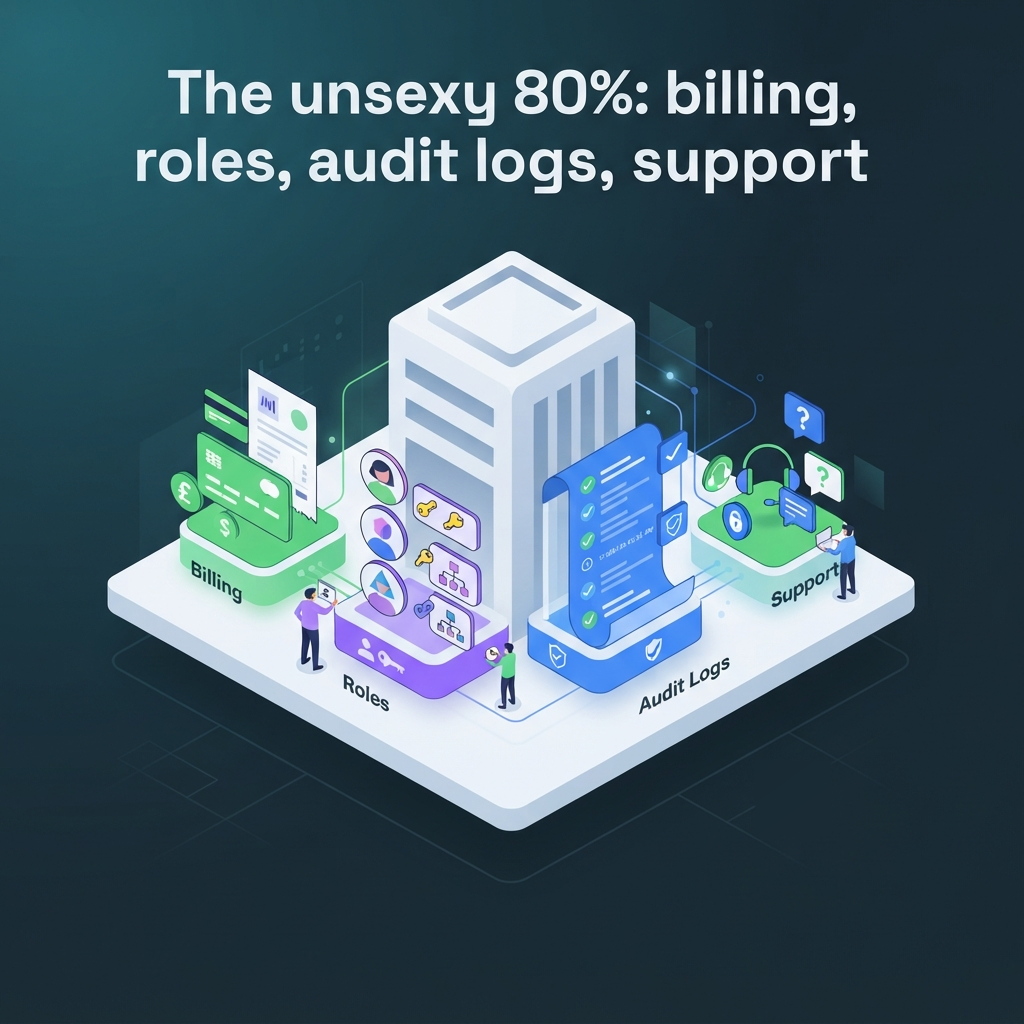
The unsexy 80%: billing, roles, audit logs, support
Demos never show the unglamorous 80% of a product: metered billing, role-based access, audit logs, SSO, onboarding, and a support team that answers when it's on fire. Rebuilding that around an agent isn't a weekend — it's a company. This is why "just replace it with an agent" underestimates the real cost of the software it wants to delete. The screen was the cheap part.
Where agents genuinely win
Agents win decisively wherever the work is glue, judgment on messy input, or a smart layer on top of tools you already pay for. Concretely: moving data between systems that don't integrate cleanly, turning unstructured input (emails, PDFs, call transcripts) into structured records, and acting as a natural-language front door to several SaaS products at once. These are exactly the jobs humans hate and that traditional automation handled brittlely. The rule of thumb for 2026: agents shine on high-toil, low-stakes, high-variance tasks — lots of drudgery, forgivable if occasionally wrong, and too varied to script cleanly. That's a big, valuable slice of real work. It just isn't "all of software." Point an agent at the glue and the messy-input problems and it earns its keep fast; point it at your billing engine and you'll spend the savings on incident reviews.
Glue work between tools
The classic win is the integration nobody built. Your CRM and your billing tool don't talk; a human copies fields between them twice a day. An agent — or honestly, a plain automation with one LLM step — does that reliably. When it needs real branching and reliability, you don't want a lone LLM loop; you want orchestration tools like n8n doing the deterministic routing and the agent handling only the fuzzy step.
Unstructured → structured tasks
Reading 200 inbound emails and turning them into tagged, prioritized tickets is a textbook agent job: the input is chaotic, the output is structured, and being 95% right with a human reviewing edge cases beats being 100% manual. This is where agents feel like magic — not because they replaced the ticketing tool, but because they fed it faster.
The "interface layer" role: an agent on top of SaaS, not instead of it
The most durable pattern in 2026 is the agent as interface: you ask in plain language, the agent orchestrates the SaaS underneath, and the packaged tools keep doing what they're good at. For some categories you don't even build this yourself — a done-for-you SEO/automation that just runs is an agent-plus-tools pipeline you rent, no loop to babysit. "On top of," not "instead of," is the whole thesis in four words.
Where agents lose to packaged software (2026 reality)
Agents lose wherever you need the same correct answer every single time, or wherever running the loop at scale gets expensive. Deterministic, high-stakes workflows — payroll, tax calculation, medical dosing, financial reconciliation, anything regulated or irreversible — belong in tested, auditable software, not a probabilistic loop, because "usually right" is a lawsuit waiting in those domains. And cost flips the naive math: a $30/month SaaS seat looks expensive until you price the tokens, the vector store, the engineering to build the agent, and the on-call time to keep it alive. As of 2026 an in-house agent that truly replaces a mature tool routinely costs more than the tool for anything past a toy scale. Agents win on toil; packaged software wins on guarantees and on the boring economics of "someone else already amortized the build across ten thousand customers."
Deterministic, high-stakes workflows
If a mistake means a compliance breach, a wrong payment, or a safety issue, you want deterministic code with tests and an audit trail — not a model that might phrase the calculation differently today. You can absolutely put an agent in front of that engine to make it friendlier. You should not let the agent be the engine.
Cost at scale and the hidden engineering bill
The seductive part of "build the agent" is that the demo is cheap. The hidden bill is maintenance: prompt drift when a model updates, new edge cases every week, monitoring, evals, and the senior engineer who now owns a fragile internal product forever. Weigh the total cost of building an in-house agent — build plus run plus maintain — against a subscription before you cancel anything. Often the tool wins on TCO by a wide margin.
Build-an-agent vs buy-the-tool: a decision framework
Before you build an agent to replace software, answer six questions honestly. The framework is deliberately biased toward "buy," because that's the cheaper, safer default and the burden of proof should sit on building. Run through them for the specific workflow — not "our whole stack," which is never the right unit of analysis:
- Is this task high-stakes or reversible? Irreversible or regulated → buy tested software.
- Do you need the same output every time? Deterministic requirement → buy; fuzzy/variable → agent is viable.
- Does a good tool already exist for this exact job? If yes, buying almost always wins on TCO.
- Do you have (and want) the engineering to maintain it for years? No standing team → don't build a fragile agent.
- Is the value in glue/judgment or in the system of record? Glue → agent; record-keeping → SaaS.
- What's the real cost at your scale? Price tokens + build + maintenance vs the subscription.
When you land on "buy," buying no longer means a signed annual contract — you can spin up an app without code in an afternoon, which sits neatly between "build a raw agent" and "sign a 12-month SaaS deal."
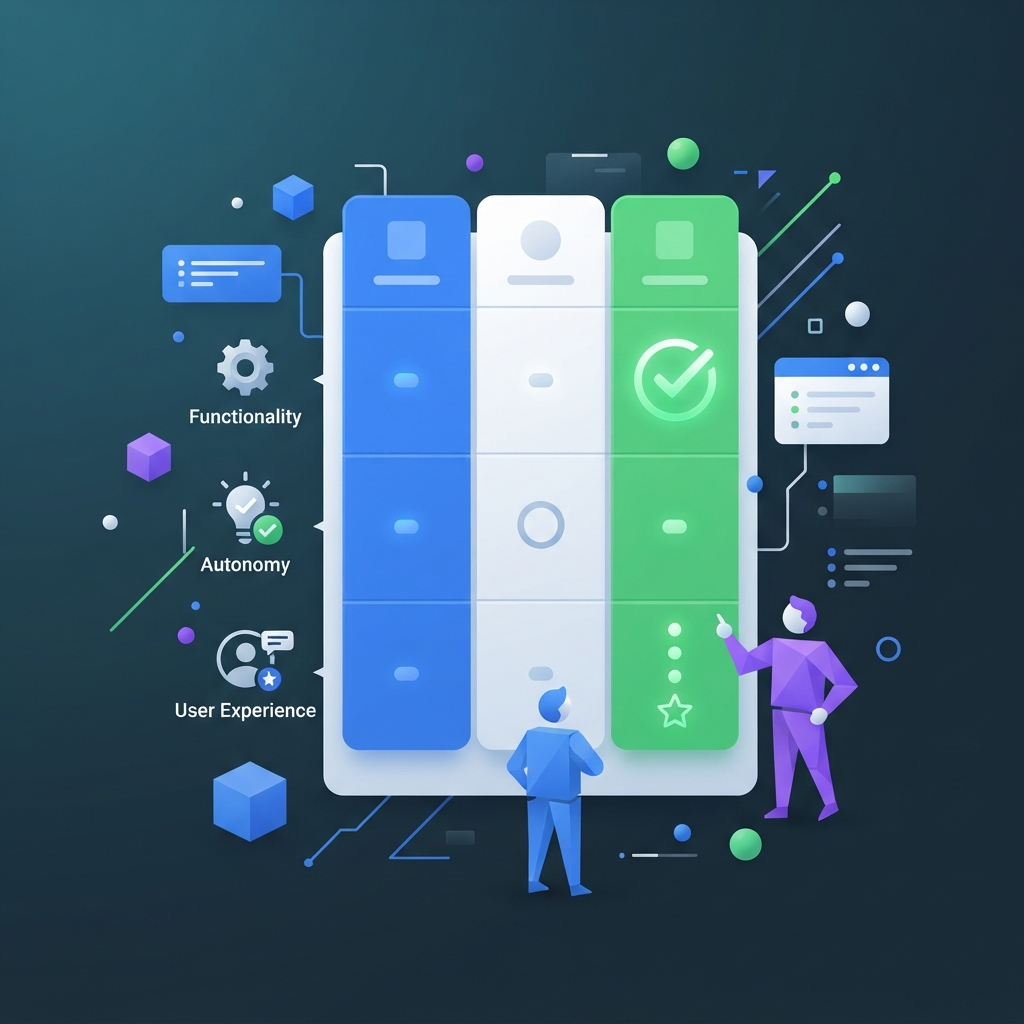
A simple scoring rubric
Score each question 0 (favors buying) to 2 (favors building) and add them up.
| Question | 0 — Buy the tool | 2 — Build the agent |
|---|---|---|
| Stakes | High / irreversible | Low / reversible |
| Determinism | Must be identical | Variation is fine |
| Existing tool | Great one exists | Nothing fits |
| Maintenance capacity | No team | Standing eng team |
| Value location | System of record | Glue / judgment |
| Cost at scale | Tool is cheaper | Agent is cheaper |
Roughly: 0–4 buy, 5–8 hybrid (agent on top of the tool), 9–12 build. Most real workflows land in the middle — which is the whole point.
Step-by-step: replace part of a SaaS workflow with an agent
You don't replace a whole tool. You replace a step. Here's how to capture the toil savings without breaking your system of record — and you can do this without a dev team; the pattern is the backbone of the AI Automation course (n8n, Make and AI agents) if you want the guided version.
1. Pick a low-risk, high-toil task
Start where being 95% right is fine and mistakes are cheap to undo — categorizing inbound leads, drafting first-pass replies, enriching records. Never start with billing, refunds, or anything a customer sees unreviewed.
2. Keep the SaaS as the system of record
The agent reads from and writes to your existing tool; the tool stays the source of truth. You're adding a worker, not migrating your data into a chatbot. This single rule prevents most disasters.
3. Wire the agent with orchestration
Put a deterministic layer around the fuzzy step. Let orchestration tools like n8n handle triggers, branching, and retries, and let the agent handle only the language-shaped part. If the task is conversational, you might build a bot as the front door and keep the logic in the workflow behind it.
4. Add guardrails + a human checkpoint
Constrain the agent's permissions to exactly the task, log every action, and require human approval before anything irreversible. A one-click "approve/reject" on the agent's proposed action keeps you fast and safe at once.
5. Measure before/after
Baseline the manual version — time per task, error rate, cost — then compare. If the agent isn't clearly better on toil without being worse on errors, kill it. Sentiment ("it feels futuristic") is not a metric.
Common mistakes teams make
The failures repeat, so learn them cheaply:
- Replacing the wrong layer. Teams replace the reliable system of record and keep the toil. Do the opposite: automate the glue, protect the record.
- No fallback. When the agent stalls, work must still route to a human or a manual path. An agent with no off-ramp is an outage.
- Ignoring maintenance cost. The build is 20% of the lifetime cost. Budget for evals, monitoring, and model drift or don't start.
- "One agent to rule them all." A single mega-agent doing ten jobs is undebuggable. Several small, scoped agents beat one omniscient one every time.
- DIY-ing the risky part. If the automation touches revenue or compliance and you're unsure, don't wing it — hire an automation expert for the piece that hurts if it breaks.
What this means for your tool budget
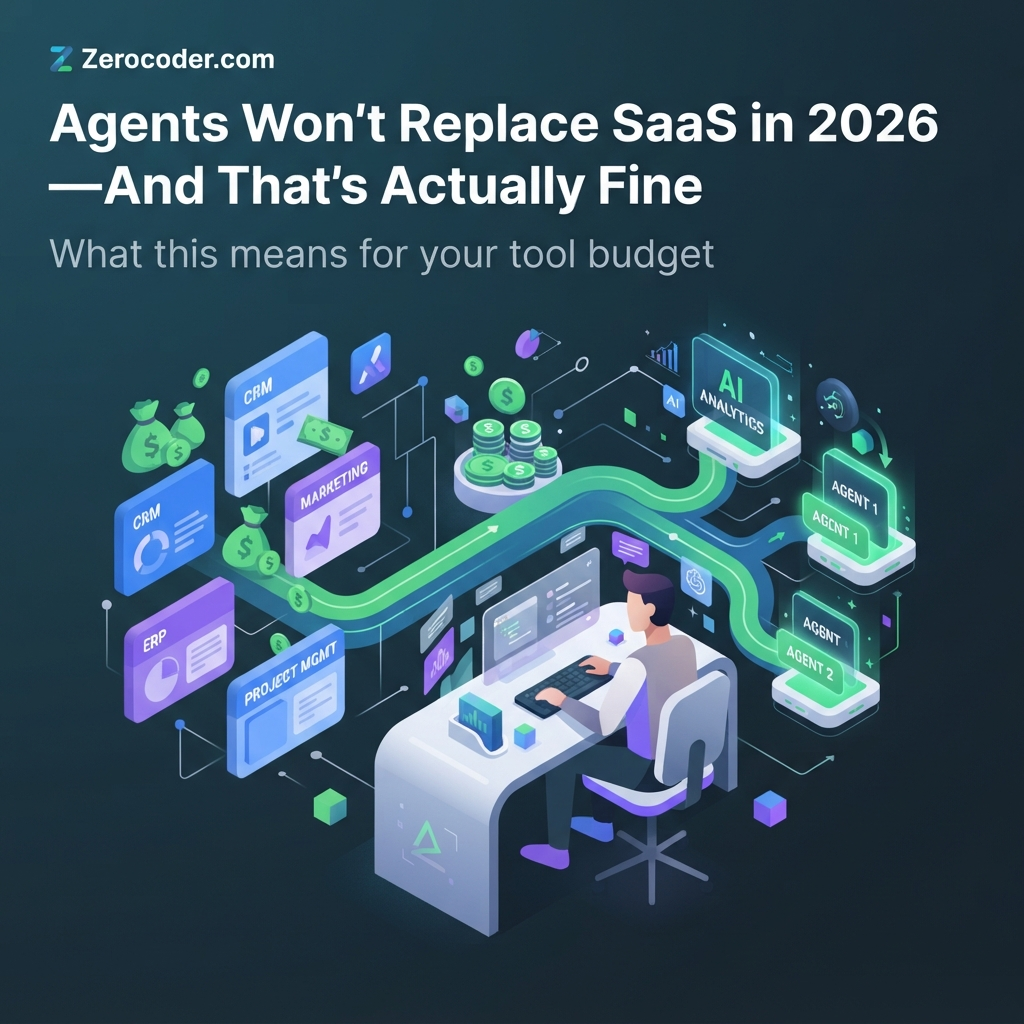
The realistic 2026 outcome isn't a smaller number of vendors because agents killed them — it's consolidation. Agents and shared AI workspaces let you drop the shallow point solutions (the fifth-best tool you barely used) while keeping the deep ones (the systems of record you can't). Your bill shifts from "a dozen single-purpose subscriptions" toward "a few deep tools plus one flexible AI layer." That's elimination of redundancy, not elimination of software — and it usually saves real money once you actually count what a sprawling stack costs.
Consolidation, not elimination
Before you cancel anything, know your baseline: it's worth auditing what a real AI tool stack costs per month, because people wildly under-count. The savings from agents come from cutting overlap, not from deleting the tools that do load-bearing work.
One workspace vs a dozen subscriptions
The most boring consolidation is also the biggest: instead of a separate login and invoice for writing, images, chat, and automation, run them from one place. Having 25+ AI tools in one workspace on a single balance is the un-sexy version of "agents changed my stack" — and it's the version that actually lowers the bill this quarter. And if you're a no-code builder worried this makes you obsolete, it's the reverse: someone has to design, wire, and maintain these agent-plus-tool stacks, which is exactly what the growing pool of Automation Engineer roles is for.
Access & pricing reality in 2026
Two pricing truths as of 2026. First, running agents isn't free — tokens, orchestration, and monitoring are real line items, and at scale they can exceed the SaaS seat you were trying to escape. Second, packaged tools keep getting AI features baked in, so "buy the tool" increasingly *means* buying the agent, bundled and maintained by someone else. The pragmatic move is to keep your fixed costs low and your flexibility high while you experiment: prefer pay-as-you-go and shared credits over a pile of annual commitments until a workflow proves itself. You can see current plans to size this for your team, but the principle holds regardless of vendor — don't sign a year of anything to test a hypothesis you can validate in a week.
What's next: the "agent + SaaS" stack
The stack that's actually winning in 2026 is layered, not either-or. At the bottom sits the system of record — your database and source of truth. Above it, SaaS logic and packaged tools that carry compliance and reliability. Above that, orchestration that routes work deterministically. And on top, the agent as the natural-language interface that plans and glues it all together. Each layer does what it's best at: the record stays authoritative, the tools stay reliable, the orchestration stays predictable, and the agent absorbs the toil and the messy edges. That's the honest future — not software's funeral, but software with a smart, supervised layer on top. Bet on the stack, not on one side of the headline, and you'll be right longer than the people forecasting anyone's death.
Frequently asked questions
Will AI agents fully replace SaaS?
No. As of 2026, agents are becoming an interface and glue layer on top of SaaS, not a replacement for it. Packaged software still owns the system of record, compliance, uptime, and data gravity — moats an agent operates but doesn't want to be. Expect shallow, single-feature tools to get absorbed; deep, record-keeping tools stay.
Are AI agents cheaper than SaaS?
Sometimes for toil, rarely at scale. A $30 seat looks pricey until you add tokens, orchestration, build time, and maintenance. For anything past a toy scale, an in-house agent that truly replaces a mature tool often costs more on total cost of ownership than just buying the tool.
Can an agent run without any SaaS behind it?
Not for real business work. Agents need somewhere authoritative to read and write — a system of record. You can put that in a backend you own, but you don't want your source of truth living inside a probabilistic loop. The agent acts on the data; the data lives somewhere reliable.
Should a startup build agents instead of buying tools?
Usually buy first. Building an agent to replace software means owning a fragile internal product forever — build plus run plus maintain. Build only when no good tool exists, the task is low-stakes and variable, and you have a standing team. Otherwise buy, or use no-code to spin up exactly what you need.
Do no-code builders still matter if agents can code?
More than before. Someone has to design, wire, guardrail, and maintain agent-plus-SaaS stacks. That's judgment and system design, not typing. The role shifts toward orchestration and automation engineering — a growing category, not a shrinking one.
What tasks should stay in SaaS?
Anything deterministic, high-stakes, or regulated: billing, payroll, tax, reconciliation, compliance-bound records. These need identical, auditable results every time. Put an agent in front to make them friendlier if you like, but keep the engine in tested software.
Is it safe to let an agent act inside my software?
Yes, with discipline. Scope permissions to exactly the task, log every action, and require human approval before anything irreversible. A confused agent with broad write access is the main risk — constrain it and it's safe for high-toil, low-stakes work.
How do I start without a dev team?
Pick one low-risk, high-toil step, keep your existing tool as the system of record, and wire the agent with no-code orchestration plus a human checkpoint. A guided automation course or a shared AI workspace with starter credits lets you prove it on one workflow before committing.
Which is more reliable, agents or workflows?
Deterministic workflows, for anything that must be identical every run. Agents are non-deterministic by design — great for fuzzy, variable input, risky for exact repeatable outputs. The best pattern uses deterministic orchestration for routing and reliability, with the agent handling only the language-shaped step.
Will this change again next year?
The balance will shift toward agents handling more, but the core stays: agents as the top interface layer over reliable software and a real system of record. Revisit annually, and bet on the layered "agent + SaaS" stack rather than either side's obituary.

