A finance analyst at a 120-person company built an internal app to track overdue invoices. It works. It holds roughly 4,000 customer records, including names, emails and payment history. It has no named owner, no backup, no data processing agreement, and it runs on a personal account paid for with a personal credit card. IT has never heard of it. Nobody is doing anything wrong here — someone solved a real problem that the backlog was never going to reach. That is the shape of the risk in 2026: not that people use AI, but that nobody can see what they built with it, or review the code it wrote. This playbook gives you three artifacts you can use this week: an inventory method, a four-tier code review checklist, and a one-page policy skeleton.
By the way — a lot of this problem is just account sprawl. Zerocoder puts 25+ AI tools in one workspace on a single account and a single balance, so there's one place to check who used what, and nobody needs a personal card to try a model. Free starter credits, no code required.
What "shadow AI" actually means in 2026
Shadow AI is any use of AI tools, AI-built applications or AI agents inside a company that IT, security and compliance do not know about and cannot audit. That definition is deliberately broad, because the exposure comes from invisibility rather than from any specific product. Shadow AI in 2026 is not one behavior. It is a chat assistant pasted full of customer contracts, an internal app built over a weekend, and an automation that quietly writes to your CRM at 3am. The common factor is that no one can answer three basic questions: who owns this, what data goes into it, and what happens if it breaks. Classic shadow IT left a trail — an install, an invoice, a server. Shadow AI often leaves nothing but a browser tab and a line on someone's personal card statement.
Three flavors: assistants, builders, agents
- Unapproved assistants. Chat and coding assistants used on personal logins. Risk: data leaving your boundary, no record of what was shared, no DPA.
- Unapproved builders. App and automation platforms where a non-engineer ships something real. A Glide app holding customer records is the textbook case: genuinely useful, completely unowned.
- Unapproved agents. Multi-step automations with write access. A Zapier workflow that reads an inbox, calls a model and updates records is software with credentials, built by someone who was never asked to think about least privilege.
Why it looks different from classic shadow IT
Three structural differences make shadow AI harder to find. There is no procurement trail, because free tiers and $20 monthly plans never reach finance. There is no install, so endpoint inventories miss it. And the spend hides inside expense reports as "software" or nothing at all. Your CASB may catch domains; it will not tell you that the app built on one of them is the only system tracking a revenue process.
The honest version
Most shadow AI is not misconduct. It is a demand signal. People build in the shadows when the sanctioned path is slow, absent or humiliating. Treat it as a queue of unmet requirements, and the rest of this playbook gets much easier to sell internally.
The numbers: what ungoverned AI actually breaks
The honest summary of the 2025–26 research is that AI-assisted development ships working code with a meaningfully elevated rate of security defects, while governance maturity lags far behind adoption. The most-cited figure comes from Veracode's 2025 GenAI Code Security Report, which tested large language models on code-completion tasks and found that around 45% of generated samples introduced a known OWASP-class weakness, with injection and cryptographic failures over-represented. On the quality side, GitClear's multi-year code-quality research has tracked rising code duplication and falling code reuse since assistant adoption accelerated, which is the mechanical signature of copy-forward development. Executive surveys through 2025 consistently put the share of leaders claiming a mature governance model for agentic AI at roughly one in five. Verify any figure against the primary source before it goes into a board deck — including these.
| Signal | Reported figure | Source (year) | What to do about it |
|---|---|---|---|
| AI-generated code introducing a known security weakness | ~45% of tested tasks | Veracode, GenAI Code Security Report (2025) | Treat AI-authored PRs as untrusted input; mandate SAST + secret scanning in CI |
| Code duplication and churn trend since assistant adoption | Duplication up, reuse down year over year | GitClear code quality research (2024–2025) | Review for duplicated logic, not just correctness |
| Quality issues in AI-authored commits | Commonly reported in the mid-teens percentage range | Vendor and platform studies (2025) — figures vary by methodology | Measure your own rate from your own PR data before setting targets |
| Leaders with a mature agentic AI governance model | ~21% | Executive surveys (2025) | Assume you are in the 79%; start with inventory |
| AI tools per knowledge worker | Routinely 3–8, mostly on personal accounts | Internal audits reported across 2025–26 | Consolidate onto one account with one balance and SSO |
What the numbers do and don't prove
These figures say "review harder", not "AI writes bad code". A 45% weakness rate on synthetic completion tasks is not a 45% breach rate in production, and most of those weaknesses die in a decent CI pipeline. What the data genuinely supports is narrower and more actionable: AI code arrives faster than your review capacity, and it fails in patterns a human reviewer is not used to looking for. One widely circulated claim — an "Anthropic study" showing 77% of AI-reliant code failing later maintenance — does not trace to a published primary source, so it is not quoted here. Where maintainability is concerned, the evidence is directional rather than precise, and it is better argued qualitatively.
Why bans don't work
A ban on unapproved AI tools at work reliably reduces visibility rather than usage. The mechanism is simple: AI tools are cheap, browser-based and immediately useful, so a prohibition moves the activity onto channels you cannot observe instead of ending it. Teams that announce bans typically see their SSO logs go quiet while output quality stays unchanged — which is the signature of migration, not compliance. The second-order cost is worse. Once using AI is a disciplinary matter, nobody tells you about the app holding 4,000 customer records, and you lose your only cheap discovery channel: voluntary disclosure. Bans are still appropriate for specific data categories and specific vendors. They are a poor default for a general-purpose capability your competitors are using to move faster.
Three predictable failure modes
- Personal accounts. Work moves to a login you do not control and cannot offboard.
- Personal devices. The phone in someone's pocket is outside every control you own.
- "It's just a spreadsheet." People reclassify what they built so it falls outside the policy's wording.
The reframe: route demand, don't block it
Replace "you may not use AI" with "here is where you use AI, and here is what you may put in it". A sanctioned path with one account, SSO and a two-day approval SLA competes on convenience, which is the only axis where the shadow path currently wins. Governance does add friction; your job is choosing which friction buys you something.
Build the safe sandbox: a 7-step path for citizen developers
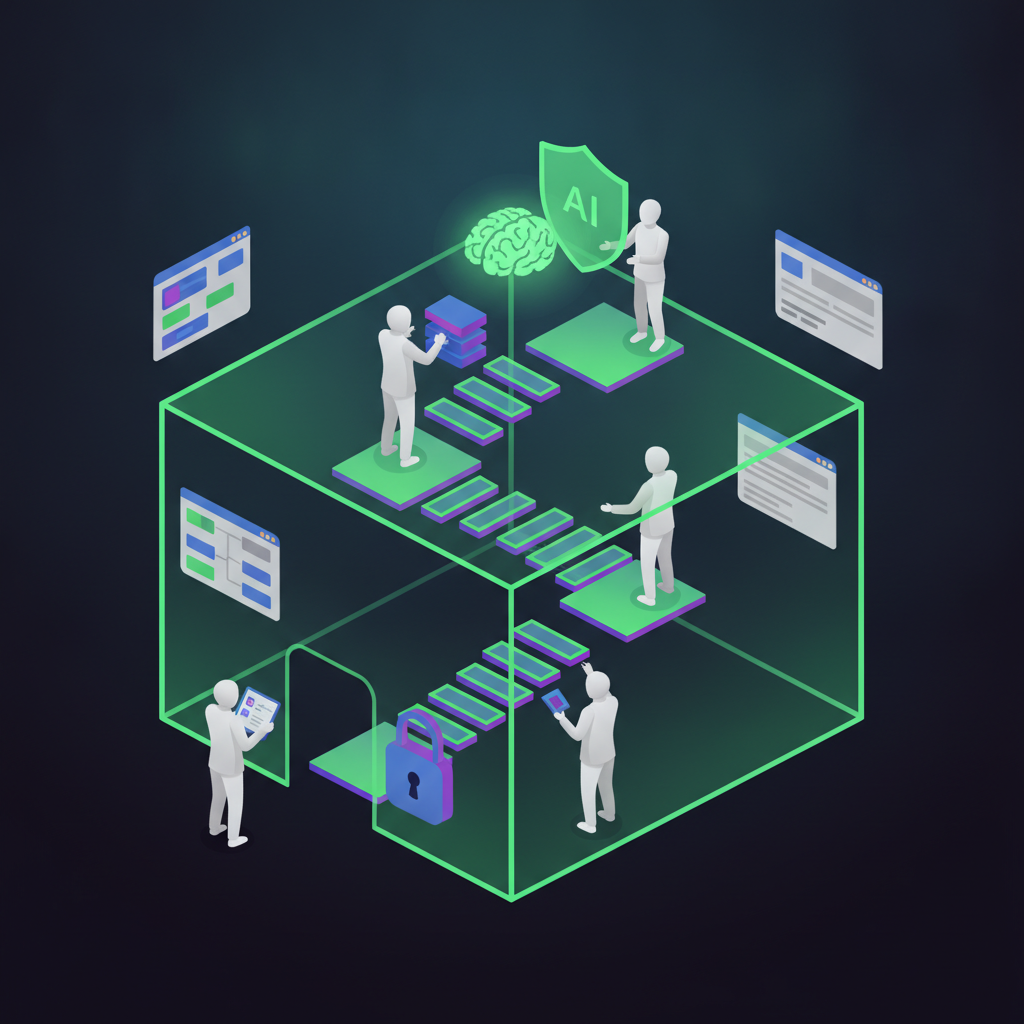
A safe sandbox is a sanctioned environment where non-engineers can build real internal tools under known limits: approved platforms, a data tier they may not exceed, a named owner, and a scheduled review. Citizen developer governance fails when it starts with a committee and a form; it works when it starts with permission plus a boundary. The goal is not to make every internal app enterprise-grade. It is to make sure that every internal app is known, owned and bounded by the sensitivity of the data it touches. These seven steps take a few weeks and most of the work is writing one page, not deploying a platform.
- Publish a one-page tiering. Three columns: public data, internal data, regulated data. State plainly what citizen builds may touch (tiers 1–2) and what they may not (tier 4).
- Give one sanctioned workspace with SSO, SCIM provisioning and a shared balance, so access is granted and revoked centrally instead of per subscription.
- Require a named owner and a review date on every app. No owner, no app. This single rule removes most orphaned-tool risk.
- Pre-approve a short tool list. Three to five platforms, vendor-reviewed once. A prompt-to-app builder like Base44 belongs here precisely because it concentrates builds where you can see them.
- Seed templates for the three most-requested app types: a request tracker, an approval workflow, a lightweight internal directory. Templates are how you set defaults without writing rules.
- Make one non-negotiable: no customer PII in sandbox builds. Synthetic or de-identified data only, until the app is promoted.
- Review monthly. Promote the three apps the business actually depends on to IT-owned systems. Retire the rest without ceremony.
Before anything gets promoted, have the owner map the entities, roles and integrations before anyone builds — a one-page blueprint catches the "it's a spreadsheet with login" problem early, when fixing it costs nothing.
The sanctioned-app intake form
Five fields, two-day SLA, no attachments:
- App name and the business problem in one sentence
- Named owner and a backup owner
- Data it will touch (pick a tier) and where that data comes from
- Systems it reads from or writes to, and whether it writes
- Expected users and desired review date
Make the approved path faster than the shadow path
If approval takes three weeks, people will keep building in the dark and you will have written a policy that generates only paperwork. Measure median approval turnaround weekly and treat anything over three days as a defect in your process, not a discipline problem in your staff.
Code review checklist for AI-generated code
AI-generated code fails differently from human code. It is confident, idiomatic-looking and wrong in the dependencies, the edges and the assumptions — which means a reviewer skimming for style will pass it. An AI generated code review checklist therefore needs to be tiered by consequence: a hardcoded credential blocks the pull request, a missing empty-state does not. The checklist below is built to paste directly into your CONTRIBUTING.md or PR template. It covers AI generated code security first, correctness second, maintainability third, and the AI-specific failure patterns last. Reviewing generated code is a different discipline from reviewing generated text; if your team also ships model outputs to users, pair this with a repeatable way to score AI output quality so the two review loops do not get conflated.
Tier 1 — stop the PR
- Hardcoded secrets, API keys, tokens or connection strings anywhere in the diff or tests
- Authentication or authorization gaps — an endpoint, a query or a job that trusts the caller
- Unparameterized queries or any string-built SQL, shell or template execution
- Missing input validation on anything crossing a trust boundary
- Unsafe deserialization of user-controlled data
- Hallucinated, abandoned or typosquatted packages — verify every new dependency exists, is maintained and is spelled correctly
- Silently permissive configuration: wildcard CORS, over-broad IAM roles, public buckets, disabled TLS verification
Tier 2 — correctness
- Error handling and empty states: what renders when the list is empty and when the call fails?
- Pagination and N+1 queries — generated data access loves to fetch in a loop
- Timezone, locale and currency handling, including rounding on money
- Race conditions and concurrent writes to the same record
- Retries and idempotency on every external call that can be charged or duplicated
Tier 3 — maintainability
- Duplicated logic that already exists elsewhere in the codebase
- Dead abstractions: interfaces and factories with exactly one implementation
- Untestable code — if it cannot be unit tested without network access, it is not done
- Missing tests for the generated branch specifically, including the failure path
- License contamination from copied snippets; CWE and SBOM entries updated where relevant
Tier 4 — AI-specific
- Outdated API usage and deprecated SDK calls from stale model context
- Invented configuration flags and settings that do not exist in the real library
- Prompt-injection surface in anything agent-facing: untrusted text reaching a model that can act
- Logging that leaks PII or PHI, including full request bodies "for debugging"
The reviewer question that catches the most
"Walk me through what happens if this input is empty."
Ask the author, not the tool. The answer separates code someone understands from code someone accepted. Agentic coding environments like Google Antigravity can produce large, plausible multi-file changes in one pass, which makes author-explains-in-review the only scaling control that still works at that diff size.
Automate the boring half
Humans should never be the first line on mechanical checks. Put secret scanning, SAST and a dependency allowlist in CI, generate an SBOM on every build, and add DAST against staging. That clears Tier 1 items 1, 3 and 6 automatically and buys your reviewers back the attention they need for assumptions and edges.
Cognitive debt: when the team stops understanding its own code
Cognitive debt is the gap between the code your team ships and the code your team understands. The term comes from MIT Media Lab's 2025 study on essay writing with LLMs, which measured reduced neural engagement and weaker recall of one's own output among heavy assistant users. The engineering analogue is familiar to anyone who has run an incident: the feature works, it passed review, and nobody in the room can say why it behaves this way under load. Cognitive debt is not an argument against AI assistance. It is an argument for keeping comprehension as an explicit deliverable alongside working code, because comprehension is what you draw on at 2am. It also shifts what you hire and develop for — see which skills still matter when AI writes the first draft.
What it looks like in practice
Friday's feature cannot be debugged on Monday. Review comments get shorter and more approving. The bus factor on a module quietly drops to zero, because the person who merged it never built a mental model of it. AI code maintainability problems rarely announce themselves as defects; they show up as slowness.
Four counter-practices
- Author-explains-in-review. The author narrates the control flow and the failure modes. Not optional for large generated diffs.
- A no-AI debugging hour. Debug one real issue per sprint by reading, instrumenting and reasoning. This is skills maintenance, not asceticism.
- Rotation on AI-built modules. Deliberately assign the next change in a generated module to someone who did not write it.
- ADRs for AI-made architectural choices. If a model picked the queue, the cache or the schema, record why in a short decision record.
Measure it
Three cheap proxies: median time-to-first-fix on incidents, review comment depth on AI-heavy PRs versus others, and a quarterly "who can modify this" audit per service. Trend lines matter more than absolute values.
A governance framework for no-code and AI tools
A workable AI governance framework rests on six pillars: inventory, data classification, access, audit trails, vendor review and human accountability. No-code governance fails when it is written as a prohibition list, because prohibition lists age badly and say nothing about the app someone shipped yesterday. The six pillars below are deliberately mechanical — each one produces an artifact you can show an auditor, a board or a skeptical engineer. Work them in order. Inventory first, because every other pillar needs to know what exists; accountability last, because naming owners is easy once you can see the estate. Expect the whole framework to fit in about a dozen lines of policy, with the detail living in forms, logs and a pre-approved tool list rather than in prose.
Pillar 1 — Inventory: how to actually find shadow AI
Four discovery channels, in order of yield: SSO and identity logs for OAuth grants to AI domains; expense reports and card statements filtered for recurring charges under $100; DNS, proxy or CASB data for AI endpoints; and an amnesty week where disclosure is explicitly consequence-free. Amnesty finds what logs cannot: the app, its owner and the business process behind it. If external exposure is part of your worry, an automated audit of what's exposed covers the public-facing half of the estate while you work the internal half.
Pillar 2 — Data classification
| Tier | Example data | Allowed tools | Approval needed |
|---|---|---|---|
| T1 — Public | Published marketing copy, public docs, open datasets | Any pre-approved tool | None |
| T2 — Internal | Process docs, non-personal metrics, draft plans | Pre-approved tools on the sanctioned workspace | Self-serve, logged |
| T3 — Confidential / PII | Customer contacts, employee data, contracts, source code | Vendor-reviewed tools with a DPA and training opt-out | Owner + security sign-off |
| T4 — Regulated | PHI, payment data, KYC, anything under sector rules | IT-owned systems only; citizen builds use synthetic data | Compliance approval, DPIA where triggered |
One page, four rows. Data classification for AI tools only works if a non-technical builder can place their data in under ten seconds.
Pillar 3 — Access
- Role-based access on every no-code platform: builder, editor, viewer. No shared logins, ever.
- Service accounts for integrations, scoped to least privilege, owned by a team rather than a person.
- Offboarding that revokes workspace access in one place — the main practical argument against per-person subscriptions.
- Quarterly access review on anything touching T3 data.
Pillar 4 — Audit trails
For every AI interaction that matters, log four things: who ran it, which model and version, which dataset or source it touched, and which output actually shipped. Add a change log on every app and four-eyes review for changes to T3 systems. Retention should match your existing log policy, typically 12 months, with shorter windows for prompt content containing personal data. Centralized key-based access makes this tractable, because one place to see every model, key and price beats reconciling six vendor dashboards nobody owns.
Pillar 5 — Vendor review
Five questions per vendor: is a DPA available, who are the subprocessors, can training on your data be disabled contractually rather than by a toggle, where does data reside, and what is the retention default? Keep the answers in a one-row-per-vendor sheet.
For model access specifically, prefer organization-owned keys over personal logins. Programmatic access through the Claude API is auditable, revocable and attributable to a service account in a way that a consumer chat session on someone's private email never will be.
The same holds for the ChatGPT API: one key per workload, rotated on a schedule, with spend visible per project rather than per employee.
Pillar 6 — Human accountability
Every app and every agent gets a named owner who is accountable for its data, its access and its retirement. Accountability does not transfer to the tool, the vendor or the model. If you cannot name the owner in one sentence, the app is not governed.
The one-page policy skeleton
- You may use AI tools for work. You may not use unapproved tools for T3 or T4 data.
- Approved tools are listed at [link]. Request additions with the 5-field form; we answer in 2 business days.
- Use your company account. No personal accounts, no personal cards, no shared logins.
- Data tiers are defined at [link]. When in doubt, tier up.
- No customer PII, PHI or payment data in prompts unless the tool is listed as T3-approved.
- Every app, automation and agent has a named owner and a review date.
- Agents with write access need scoped credentials, a spend cap and an action allowlist.
- AI-assisted code follows the standard review checklist. The author explains the diff.
- Generated code is your responsibility once you open the PR.
- Log retention and monitoring follow the existing security policy.
- Disclosing an existing unapproved tool carries no penalty. Hiding one does.
- Questions go to [owner]. This policy is reviewed quarterly.
No-code doesn't mean no-governance: regulated industries
In regulated environments the question is never "is this tool allowed" but "can you produce evidence of control". No-code GDPR compliance and no-code HIPAA compliance both hinge on the same three things: a lawful basis or permitted purpose for the data, a contract with every processor touching it, and logs that let you reconstruct who did what. Citizen-built applications can satisfy that bar, but only for a narrow slice of data, and only when someone is accountable for them by name. The pragmatic line most teams land on is simple: regulated data stays in IT-owned systems, and citizen builds work with synthetic or de-identified data until an app earns promotion.
GDPR
Establish lawful basis before the build, not after. A DPIA is triggered by large-scale processing of sensitive categories or systematic monitoring — plenty of internal AI tools qualify. Apply data minimization to prompts specifically: a model does not need the whole record to classify one field. Map the processor chain, including subprocessors, and check transfer mechanisms and residency for every vendor in it.
HIPAA
PHI in prompts is disclosure. Use a vendor that will sign a BAA, apply minimum-necessary to what you send, and log access to anything that resolves to a patient. Most consumer AI subscriptions cannot support this, which is the real reason personal accounts are a compliance problem rather than a policy preference.
Financial services
Expect model risk management expectations to extend to AI-assisted tooling: documented purpose, documented limitations, change control with approval evidence, and a retained audit trail. Auditors ask for artifacts, so generate them as a byproduct of the workflow rather than reconstructing them at examination time.
This is practical guidance, not legal advice. Regulatory interpretation varies by jurisdiction and sector — run your policy past counsel and your DPO before you rely on it.
The agentic gap: governing software that acts
Agentic AI governance is a different problem from assistant governance, because an agent does not produce a suggestion for a human to accept — it takes actions with credentials. Read-only agents that summarize a dashboard sit in roughly the same risk class as a chat assistant. Write-access agents that update records, send messages, move money or modify infrastructure are production software, and they deserve the controls you already apply to production software. Most governance programs in 2026 cover chat and ignore this entirely, which is how a prompt in a customer email ends up triggering a refund. Scope the risk honestly rather than dramatically; it helps to understand what agents actually automate today before you write controls for what they might do tomorrow.
Minimum controls for any write-access agent
- Scoped credentials. A dedicated service account with least privilege, never a human's token.
- Spend caps. Hard limits per agent per day, with alerting before the ceiling.
- Action allowlists. Enumerate permitted operations. Default deny everything else.
- Dry-run mode. Log intended actions for a week before enabling execution.
- Human approval on irreversible steps: payments, deletions, external communications, production config.
- A kill switch that any on-call engineer can pull without a deploy.
Logging an agent is not logging a chat
Capture the trigger, the plan, each tool call with its parameters, each external response, the final action taken, and the identity used. Prompt-injection surface is wherever untrusted text reaches a model that can act, so log the untrusted input alongside the action it produced — that pairing is what makes an incident reconstructable.
A 30/60/90-day rollout
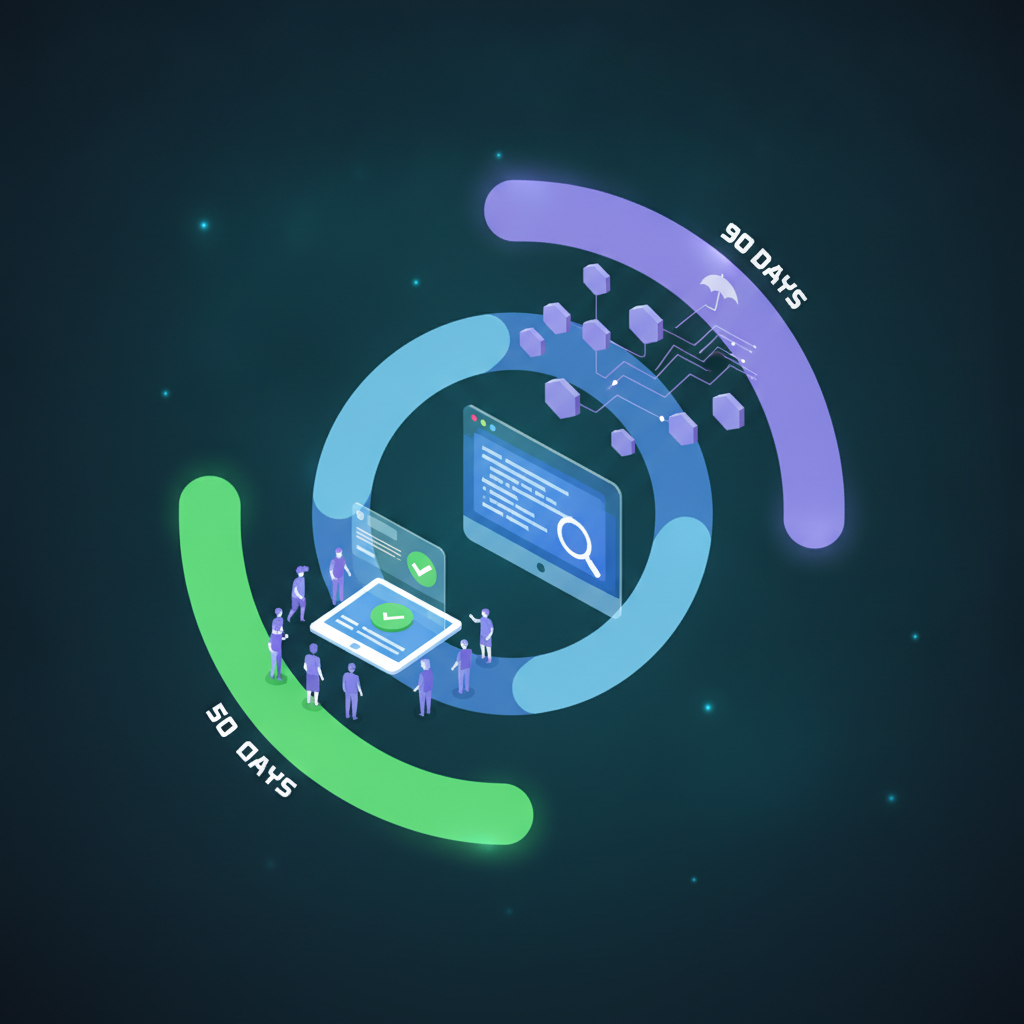
Shadow AI governance works best as a sequence, not a launch. The first 30 days buy visibility, the next 30 buy a sanctioned path, and the final 30 buy enforcement you can actually sustain. Keep one named owner for the whole program, and keep each phase's deliverable to something you could show a board in one slide.
| Phase | Actions | Owner | Deliverable | Success metric |
|---|---|---|---|---|
| Days 1–30 | Amnesty week; pull SSO, expense and DNS data; draft the 4-tier classification; name an owner per discovered app | CTO or IT director | Inventory sheet + data tier one-pager | % of AI spend visible (target 80%+) |
| Days 31–60 | Stand up one sanctioned workspace with SSO; pre-approve 3–5 tools; publish the 12-line policy and the 5-field intake form; add the review checklist to the PR template | Eng lead + security | Sanctioned path live, policy published | Median approval turnaround under 3 days |
| Days 61–90 | Migrate personal accounts; enable secret scanning, SAST and SBOM in CI; apply agent controls; retire or promote discovered apps; first monthly review | Program owner | Audit trail + retirement log | % of live apps with a named owner (target 100%) |
Phase 1 is the one teams skip for lack of hands. If that is you, bring in an automation specialist for the audit rather than letting the inventory slip a quarter — discovery is the dependency for everything downstream.
Seven mistakes teams make
Most governance programs fail in predictable ways, and almost all of them are failures of design rather than effort. The pattern is consistent: too much policy, too little path. Watch for these seven.
- A 20-page policy nobody reads. If it does not fit on one page, it does not change behavior.
- Banning tools before offering an alternative. This converts visible usage into invisible usage within a week.
- Treating AI code review as a linting problem. Linters do not catch invented dependencies or missing authorization.
- Letting every team buy its own subscriptions. No audit trail, no spend control, no offboarding, and AI tool sprawl becomes a finance problem as well as a security one.
- No named owner per app. Unowned apps are the only ones that genuinely surprise you.
- Punishing disclosure. You are closing your cheapest discovery channel to make a point.
- Governing chat assistants and ignoring agents with write access. The assistant drafts an email; the agent sends it.
What it costs — and how teams get access
The cost comparison that decides this usually is not tool price, it is the price of not knowing. Fourteen personal subscriptions at $20 to $40 a month on individual cards cost roughly the same as one governed workspace, but they produce no audit trail, no spend ceiling, no SSO, and no way to cut access when someone leaves. Consolidation is primarily a visibility purchase; the per-seat savings are a bonus. Most of the supporting tooling is already in your stack — secret scanning, SAST, SSO and centralized logging are standard, and the incremental work is turning them on for AI-authored changes rather than buying something new.
| Dimension | Scattered personal subscriptions | One governed workspace |
|---|---|---|
| Spend visibility | Expense reports, after the fact | One balance, per-project attribution |
| Offboarding | Per tool, usually missed | One revoke via SSO/SCIM |
| Audit trail | None you can access | Who, which model, when |
| Vendor review | 14 unreviewed DPAs | Reviewed once, centrally |
| Procurement effort | Continuous, invisible | One cycle |
Pilot it cheaply before committing: one team, 30 days, starter credits, then decide on evidence. If you want the operating model behind that, look at how teams run this on one account and one balance, and size the pilot against current plans and credits rather than a full procurement cycle.
What's next: where to start this week
Three actions fit into a single Monday. Announce an amnesty week with explicit no-consequence wording. Publish the four-tier data one-pager, even in draft. Paste the Tier 1 checklist into your pull request template. That combination gives you visibility, a boundary and a control gate before you have written a policy or bought anything — and it makes the rest of this playbook a matter of iteration rather than a project.
Enablement is the part most programs underfund. The people building shadow apps are already motivated; they need patterns, not prohibition, so train the people already building (no-code AI automation course) and have reviewers walk through the four tiers on a real PR together. Longer term, someone needs to own the sanctioned path as an actual job — in many teams that lands on a platform engineer, and increasingly on a dedicated role, which is worth considering if you are already hiring for an automation engineer role.
Revisit the inventory and the stats in this playbook quarterly. Both the tooling and the regulatory picture move faster than annual policy cycles, and a governance document that is a year old is usually describing a company that no longer exists.
FAQ
What is shadow AI, in plain terms?
Shadow AI is any AI tool, AI-built app or AI agent used for work that IT and security do not know about and cannot audit. It covers chat assistants on personal logins, internal apps built on no-code platforms, and automations with write access to business systems. The defining feature is invisibility, not the specific product.
Is shadow AI illegal, or just risky?
Usually just risky, but it can become a legal problem fast. Putting personal data into a vendor with no data processing agreement can breach GDPR; PHI in a tool without a BAA can breach HIPAA. The tool is not illegal — the uncontrolled data flow is what creates exposure. Classify the data first and the legal question usually answers itself.
How do we find out which AI tools employees already use?
Combine four channels: OAuth grants in your identity provider, recurring small charges in expense reports, DNS or proxy logs for AI endpoints, and an amnesty week where disclosure carries no penalty. Logs find the tools; amnesty finds the apps, their owners and the business processes behind them. Run all four in the same 30 days.
Should we ban AI-generated code?
No. Bans on AI-generated code move the activity out of your review process rather than ending it. A better control is attribution plus review: the author owns the diff, explains the control flow in review, and the pull request passes secret scanning, SAST and a dependency check. Reserve hard prohibitions for specific contexts, like regulated code paths.
What's the single most important check in an AI code review?
Authorization. AI-generated code frequently implements the happy path correctly while omitting the check that this caller may perform this action on this record. Hardcoded secrets are a close second, but automation catches those reliably. Authorization gaps need a human who understands the domain, which is why they belong at the top of the Tier 1 list.
How much AI use is "too much" for a developer?
There is no useful percentage. The practical threshold is comprehension: if the author cannot explain what happens on an empty input, a failed call or a concurrent write, the AI use has exceeded their understanding on that change. Measure time-to-first-fix and review comment depth instead of counting generated lines.
Who is accountable when an AI-built internal app leaks data?
The company is accountable externally, and internally the named owner of the app is. Accountability never transfers to the tool, the vendor or the model. This is exactly why every app and agent needs an owner on record — not to assign blame after an incident, but to ensure someone is reviewing access and data before one.
Can citizen developers build anything in a HIPAA or GDPR environment?
Yes, within a narrow lane. Citizen builds work well for tier 1 and tier 2 data: internal trackers, request forms, dashboards over non-personal metrics, and prototypes on synthetic or de-identified data. PHI, payment data and large-scale personal data stay in IT-owned systems with a signed BAA or DPA. Promote proven apps into those systems rather than widening the sandbox.
What does a minimum viable AI policy contain?
Six elements on one page: approved tool list with a request route and an SLA, a four-tier data classification, a company-account-only rule, a named owner and review date per app, specific controls for agents with write access, and a no-penalty disclosure clause. Everything else — retention, vendor review, logging — can reference your existing security policy.

